Neural Network Learning Platform
Welcome, and thank you for participating in this study for my bachelor’s thesis.
This platform is designed to help you understand how neural networks work through simple interactive examples.
No previous knowledge is required. Everything will be introduced step by step.
For evaluation purposes, certain user interactions are logged and the time spent on each page is measured. This data is collected anonymously and cannot be linked to you personally.
Questionnaire
Before starting, please open the questionnaire and start filling it out. You will return to it after completing the interactive examples.
A Decision Machine
A neural network can be thought of as a decision machine. It receives some information, processes it, and produces a result.
For example, a neural network can be trained with images of different flowers. When it receives a new image, it can decide which type of flower is shown.
A neural network can also process music. It might listen to a short audio recording and decide which song or music genre it belongs to.
Other neural networks can recognize handwritten numbers, detect objects in photographs, or decide whether an email is spam.
The information given to the network is called the input.
The decision produced by the network is called the output.
What's Coming
You will work through four interactive examples that gradually introduce how neural networks make decisions and learn.
Each example introduces additional concepts and allows you to interact with a neural network. Follow the instructions displayed on each page and experiment with the available controls.
Inside the Network
This is a visual representation of the simple neural network used for this task.
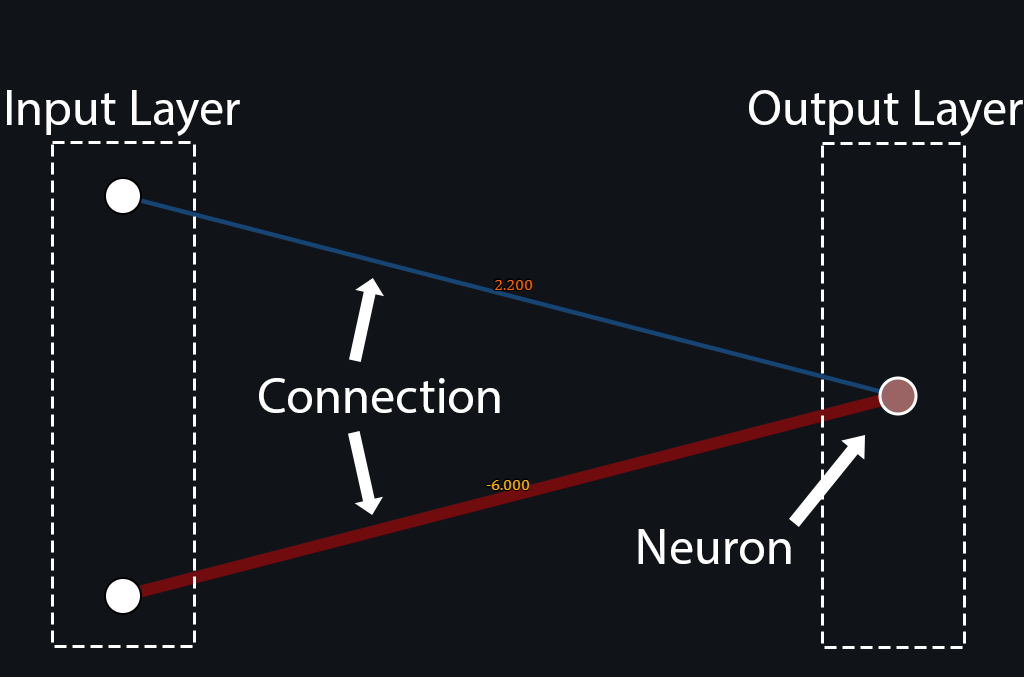
Neural networks are made of small processing units called
neurons, which are organized into layers.
The neurons are numbered for each layer beginning at one.
The two neurons on the left form the input layer. They receive the information given to the network. The number of input neurons depends on how complex the input data is.
The neuron on the right forms the output layer. It produces the network's decision. The number of output neurons depends on how many possible decisions the network can make.
The information travels from the input layer to the output layer through the connections between the neurons. The color and thickness of each connection show how strongly it affects the decision of the neuron.
Weights and Biases
Click on any neuron outside the input layer to open its edit menu.
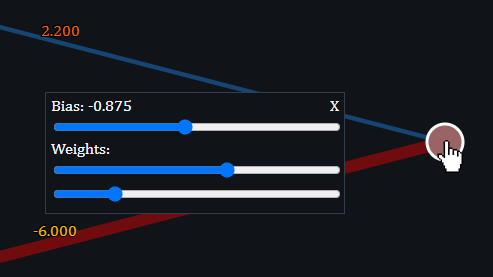
Think of the weights and bias as adjustable knobs that control the network.
A weight controls how much an input influences the decision, while the bias shifts the decision toward one result or the other.
In the next example, you will adjust these values yourself.
Your First Task
The colored dots below show examples that the network should classify correctly.
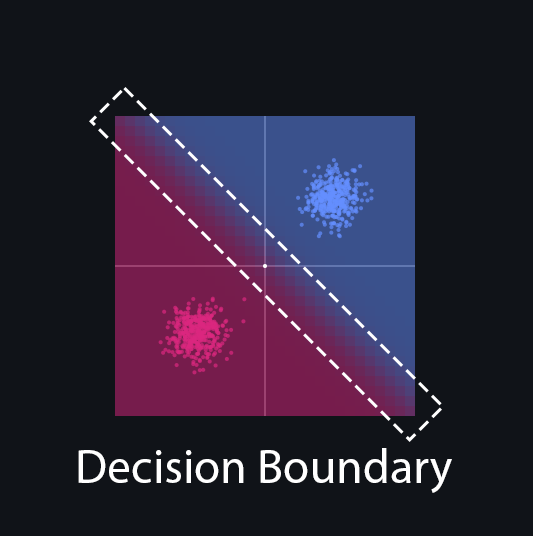
The background shows the network's current prediction. The border between the RED and BLUE areas is called the decision boundary.
Your task is to adjust the weights and
bias until the background matches the dots
as closely as possible.
This is essentially training the network by hand.
Later, you will let the network make these adjustments automatically.